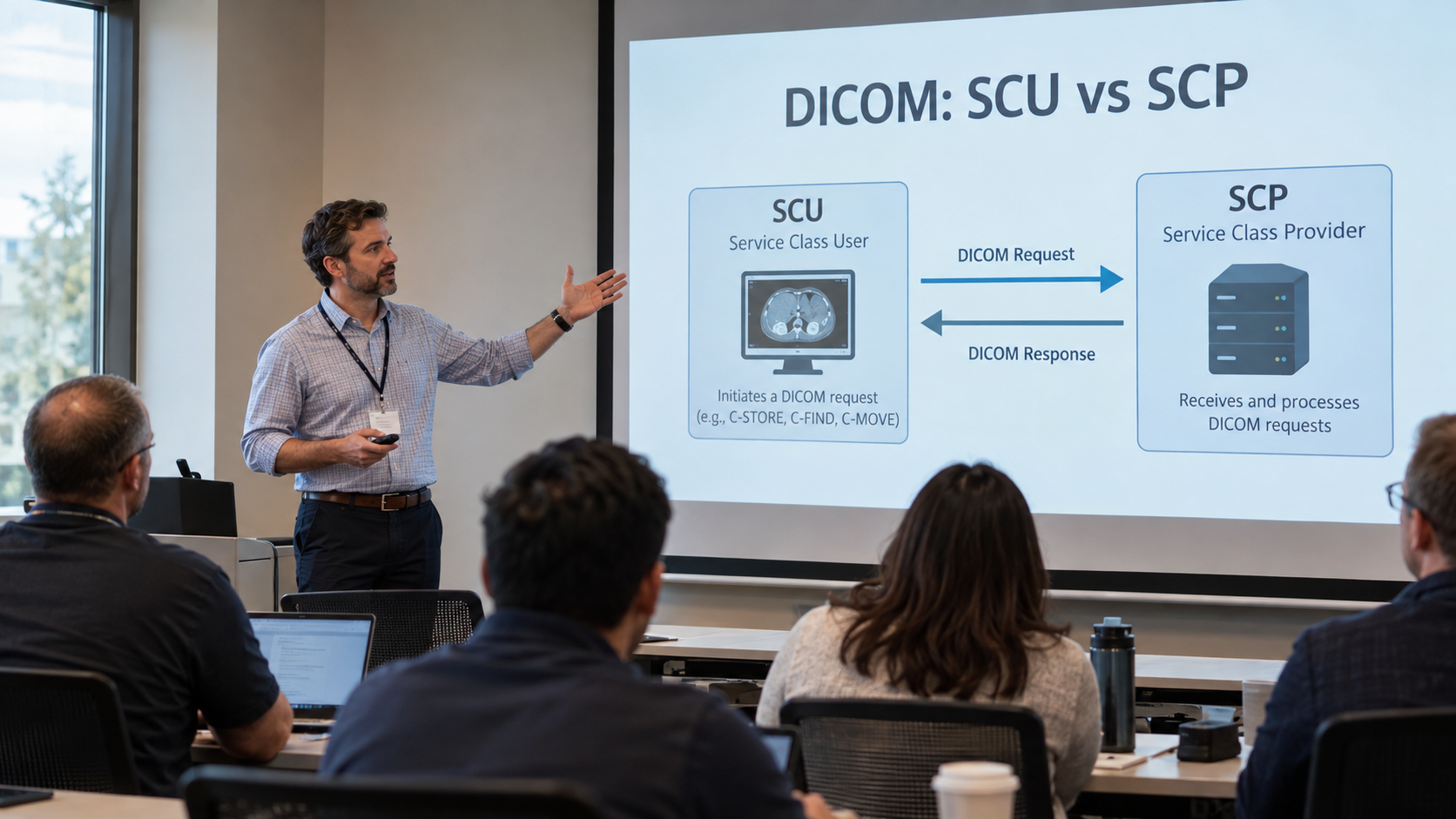
A very common path into PACS administration, clinical applications and similar imaging informatics roles starts on the clinical side. A technologist may spend years working directly with patients, modalities, radiologists and imaging workflows before moving into a support or application role.
That clinical background is extremely valuable. These are people who already understand how imaging is performed, how the workflow functions and, perhaps most importantly, how clinical users describe the problems they encounter.
But those problems rarely remain entirely clinical.
A radiologist, for example, may say that the correct series is not consistently appearing in the correct viewport. From the radiologist's perspective, that is a clinical workflow problem. The person supporting that workflow first needs to understand exactly what is wrong and why it matters.
Very quickly, however, the conversation may become technical.
What information is the system using to identify the series? Is it relying on Series Description? How consistently is that populated? Are other DICOM attributes available? What does the application actually support?
It is still the same problem. But now it needs to be understood well enough technically that it can either be investigated by the support person or communicated effectively to a vendor, engineer or another technical resource.
And the translation has to work in both directions.
The person working with the clinical user needs enough technical understanding to explain the problem accurately, ask meaningful questions and understand the answer. At the same time, whatever technical solution is proposed still has to make sense in the context of the clinical workflow that created the requirement in the first place.
In many imaging informatics support roles, understanding both sides is not simply an advantage. It is central to doing the job effectively.
I know how long it can take to build that breadth of understanding. When I first left clinical practice and moved from working as an X-ray technologist into an application specialist role, my strength was very much on the clinical side and at the front end of the application. Building a deeper understanding of DICOM, HL7, integrations and the technical side of imaging informatics took years.
Eventually, that technical depth made me far more effective across the broader domain. But taking years to develop it is hardly an ideal path if we can help people establish that foundation more efficiently.
That is where context becomes important.
For someone coming from a clinical background, the difficulty is not necessarily learning technical terminology. The harder part can be understanding what that terminology actually means in relation to the workflow they already know.
Technical subjects can become complex very quickly. Sometimes that depth can obscure the practical context underneath it.
A learner may understand what a term means. They may be able to explain a concept or answer a question about it. But recognizing that same concept when it appears inside a real workflow problem is something different.
That distinction matters because imaging informatics support is highly applied.
We live in the enterprise era, with shared systems and increasingly sophisticated technology supporting imaging across organizations. What appears highly automated to the end user may depend on significant configuration, integration and design behind the scenes.
And those decisions ultimately have to support clinical workflow.
An order may originate in one system as an HL7 message, travel through an interface engine, be received by the RIS and ultimately be translated into DICOM information used by the imaging equipment. From there, that information can continue through the workflow until it reaches the radiologist as part of the final DICOM study.
A missing or misconfigured value in the original HL7 order message can therefore travel through the entire workflow, survive transformations between standards and systems, and ultimately result in information being missing or incorrect when the study reaches the radiologist for interpretation.
DICOM matters. HL7 matters. The applications matter. But understanding how those pieces relate to the workflow matters just as much.
That creates an interesting educational challenge.
Imaging informatics education has never been purely theoretical. Practical exercises and hands-on labs have long been an important part of learning the discipline. The issue is not whether we need theory or practice. We clearly need both.
The more interesting question is how effectively the technical concepts, practical exercises and clinical workflow are connected.
Someone coming from clinical imaging already understands patients, orders, modalities, examinations and workflow. Technical concepts such as DICOM attributes, HL7 messages, identifiers and application behaviour add another layer to that understanding.
The challenge is making sure that layer does not become separated from the clinical context that gives it meaning.
A technical concept can be explained perfectly accurately and still remain difficult to apply if its relationship to the workflow is not clear enough. The learner may know what something is without being completely comfortable recognizing where it matters or what it means when something goes wrong.
That may be particularly important when establishing the initial technical foundation.
Once that foundation genuinely makes sense, new information has somewhere to fit.
A new interface is no longer just another interface. A DICOM attribute is not simply another tag to remember. A new application is not an entirely separate black box. Each can be connected to an existing understanding of how information moves through the imaging workflow.
That makes deeper learning easier when it becomes necessary and creates greater self-sufficiency over time.
The objective is not for every clinically trained imaging informatics professional to become an engineer or to know every part of DICOM, HL7 or every system they may encounter.
The objective is to develop enough technical understanding, in enough clinical context, that the next problem does not require starting from zero.
Perhaps that is the real educational opportunity.
If imaging informatics support depends on understanding both the clinical problem and the technical mechanisms behind it, how do we make that connection as clear, practical and efficient as possible for the people learning the discipline?